
Legitimate concerns
How not to talk about a pogrom

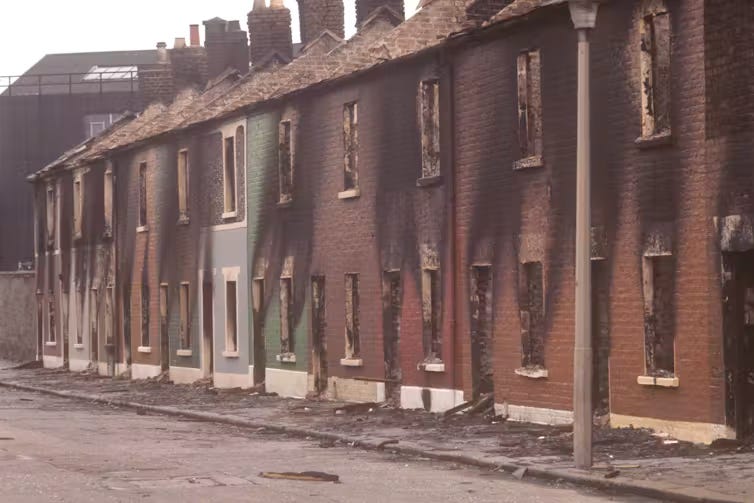
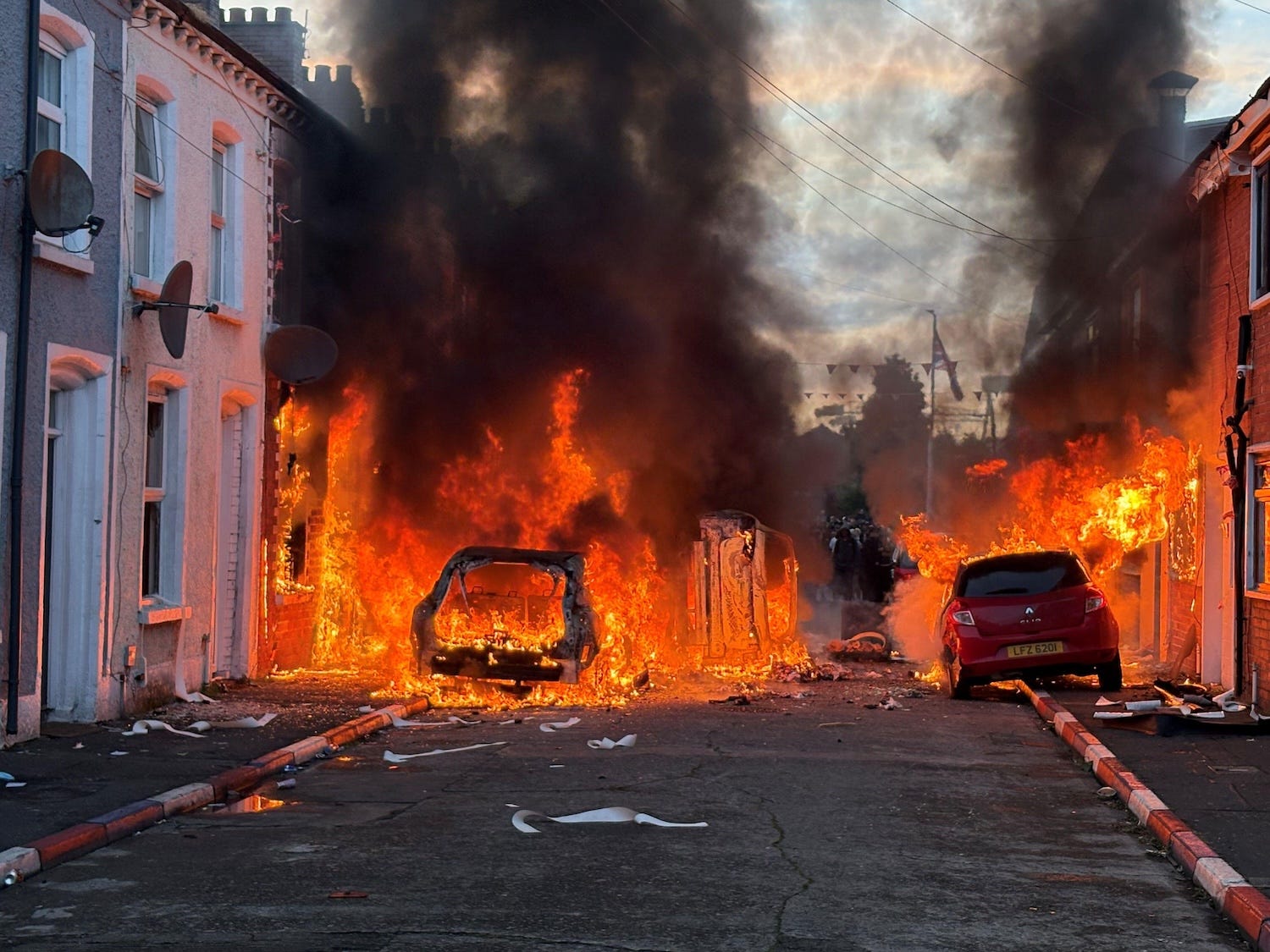
Over two nights this week, hundreds of masked men moved through parts of Belfast with petrol bombs and a list of addresses. They kicked in doors, smashed windows and set fire to people’s homes. The fire brigade attended dozens of blazes in a single night. A bus was torched, a Middle Eastern supermarket gutted, a Turkish barber’s wrecked. A woman who had escaped an actual warzone said she was more frightened here than she had been there.
The narrative has been a tidy one - a Sudanese refugee brutally attacked a local man in the middle of a North Belfast street. Enraged and frightened, protestors took to the streets to express their concerns for community safety. A small minority turned it violent.
The stabbing happened on Monday 8 June. Two days before, in the early hours of Saturday 6 June, a former gospel hall on the Shankill Road was set alight and gutted. An Indian couple had bought the long-derelict building and were turning it into a grocery selling vegetables, rice, spices. They are Hindu and vegetarian, which did nothing to stop a weeks-long online campaign of intimidation and invented grievance against them, including the Islamophobic lie that the shop would sell halal meat. The fire service found the blaze had been started deliberately at the roof and the police treated it as racially motivated. As the couple stood in the ruins of their life savings, people drove past honking and laughing.
The knife attack did not start anything. It simply handed a bigger pretext to people who were already at it.
Let’s name it honestly. The leader of the SDLP called it a race-based pogrom. The First Minister called it thuggery and cowardice. Language matters because a great deal of the commentary, most loudly from people who have no idea how this city works, is already busy mistranslating it into something that belongs to another place.
The translation goes like this: the scenes are ugly, but look past them and you’ll see that ordinary people have legitimate concerns about immigration which the political class has refused to address, and so what we really need now is a frank, grown-up conversation about migration.
We do not. And the surest sign that someone does not understand the North is that they think we do.
The machinery is older than the Troubles. In 1920, as this state was being built, loyalist mobs drove thousands of workers out of the Belfast shipyards - Catholics, and the socialists they called "rotten Prods" and burned families from their homes; Fr John Hassan who counted the dead called it the Belfast pogrom, and the name has stuck for a century. The target keeps changing. The machinery stays the same.
What the outsiders’ gaze misses is obvious to anyone who has lived here long enough to learn the local grammar of glances, euphemisms, and silence. The reason a single misspelled social media post can close a city is that everyone here knows who sends it and what they are capable of. This is the third consecutive summer of organised racist violence in Belfast, timed as it always is to the approach of the marching season. To report this as “Britain’s immigration tensions arriving in Northern Ireland” is to miss that Northern Ireland built its own apparatus for this work a century ago, only now it is pointed at someone new.
The footage of the stabbing that took place on Monday night was pushed across the world by Elon Musk, by Nigel Farage, by Tommy Robinson, figures who would struggle to find this place on a map. Their words gave the fire its oxygen. But to stop there and lay the whole thing at the doorsteps of social media and foreign billionaires, however insidious, is just another way of not seeing this place. Online commentators can fan the flames but local paramilitary structure is what turns a viral clip into sixty fires in a night.
That does not mean there is nothing real here to address. The streets being targeted are among the most deprived in the city, starved of investment long before the refugees arrived, and into them the Home Office and its private contractor, Mears, have placed traumatised people fleeing war and persecution with little consultation and less support. In Northern Ireland, unlike in Britain, Mears carries no obligation to spread asylum seekers across council areas; it has concentrated the large majority in a handful of the poorest postcodes, because that is where the cheap accommodation is and because doing so has been astonishingly profitable. That is a broken system. It fails the refugee and the host community, and sets them against each other by design.
Anger at that broken system is legitimate, and it is not racism: you can be furious at the Home Office and at Mears without wishing harm on a single refugee. But what was done on these streets was racism, full stop: a decision to burn people out for the colour of their skin is not misdirected economic anxiety. They do not want the system fixed. They want the people gone.
I have spent years arguing for deliberative democracy, for enabling communities to reason together about the decisions that shape them. For creating infrastructure that ensures that people feel heard. So yes, we do need a conversation. Just not one that begins by accepting a false premise: that the problem is migration. The real questions are whether Mears should keep a contract it has milked, whether the Home Office should be made to resource the communities it leaves to cope alone, and what it would take to house asylum seekers with dignity and a say rather than drop them into the cheapest available misery. Or how we build enough new infrastructure to address the housing crisis that feeds these grievances. Those are the problems we need to talk about.
What is needed from that conversation is a public mandate for a long-overdue intervention; one that breaks the pattern by starting with the people in the firing line and not those pulling the triggers: families protected in their own homes and supported to stay, rather than quietly moved on for their own safety, and a state that names the burning-out of neighbours as the organised racist violence it is instead of a public-order problem to be waited out.
We need an intervention that ends the impunity of violent actors, not by parading a handful of groomed teenagers through the courts for the cameras, but by dismantling the power that lets these gangs control and terrorise their own neighbourhoods. Those communities deserve compassion and a way out. Rebuild the placement system around partnership and investment rather than the cheapest postcode and the fattest margin, so that a real grievance is met by repair instead of left to fester as a recruiting tool. And a demand that our political leaders, here and in London refuse to launder a pogrom into a "legitimate concern."
Despite being one of our most pervasive symbols, masked men are not the whole of this place, and they only get the last word if we let them. On the same streets, through the same nights, other people were carrying food parcels to families too frightened to open their doors, and clearing the wreckage once the fires were out. They were providing safe transport for the children of affected families who, after a night of being under seige, needed to make it to school in time to sit their GCSEs. They’ve offered spare rooms and sofas to people who desperately and suddenly need shelter. That is Belfast too - the part the cameras don’t see and the billionaires can’t use.
A pogrom is not an argument, and you do not challenge it by agreeing with its premise. None of this was ever a debate, and the masked men were never making an argument. They were making a claim: that they decide who belongs here. Whether they are right is up to the rest of us.
Where were the riots when Stephen Ogilvie was drugged and set on fire by a white Ulster gang leader?
Great piece Rebekah